
Chapter 1: Saint John the Baptist and the Secret of New Beginnings
The one thing you need to do at the start of the Camino

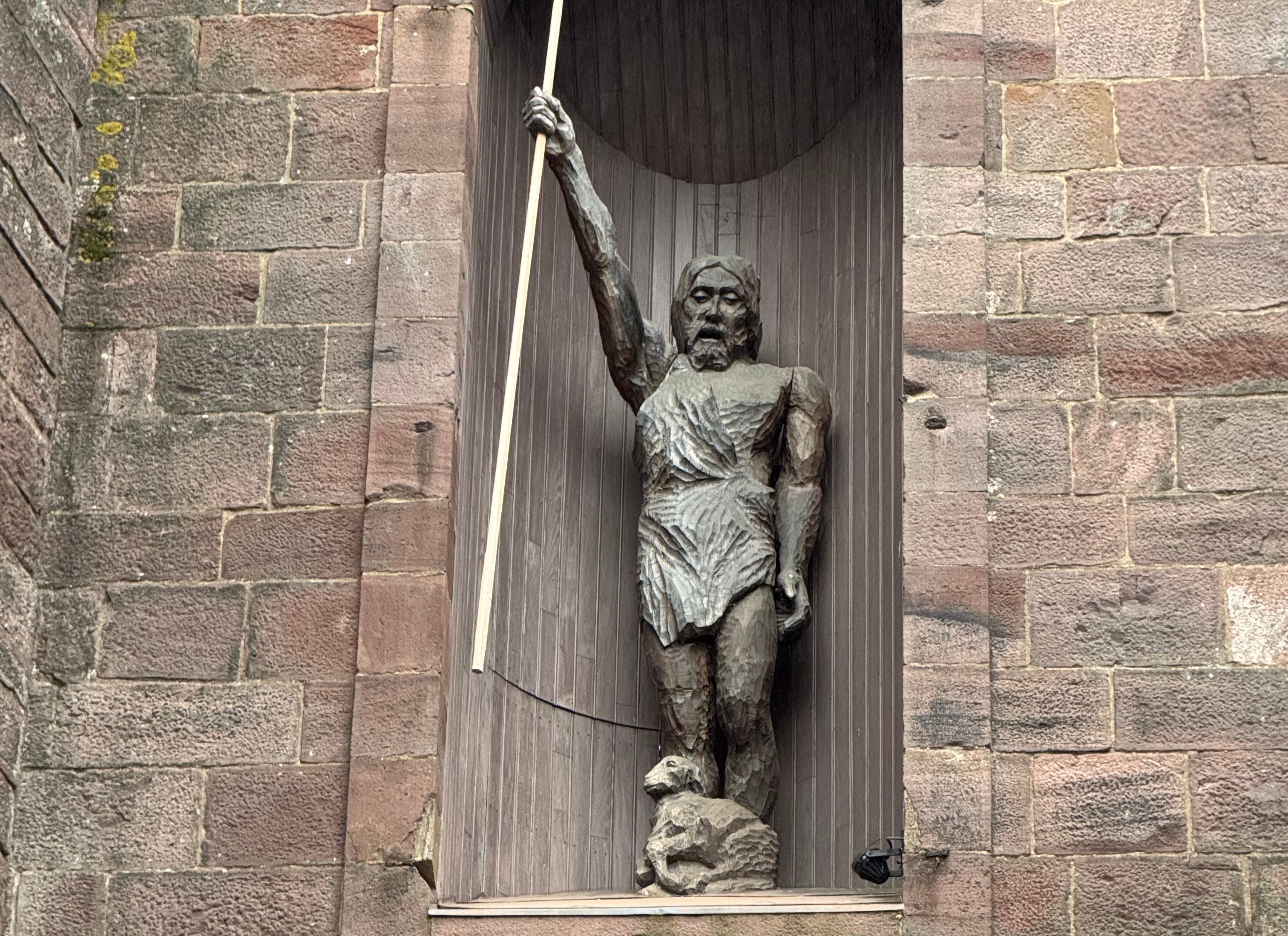
Before crossing the Pyrenees from Saint-Jean-Pied-de-Port, I passed beneath the statue of John the Baptist. That turned out to be no coincidence.
Join me as I retrace my pilgrimage to Santiago de Compostela, weaving together my own experiences with the stories of the saints, churches and traditions that have shaped this ancient route for centuries.
You can find all published chapters in the table of contents.
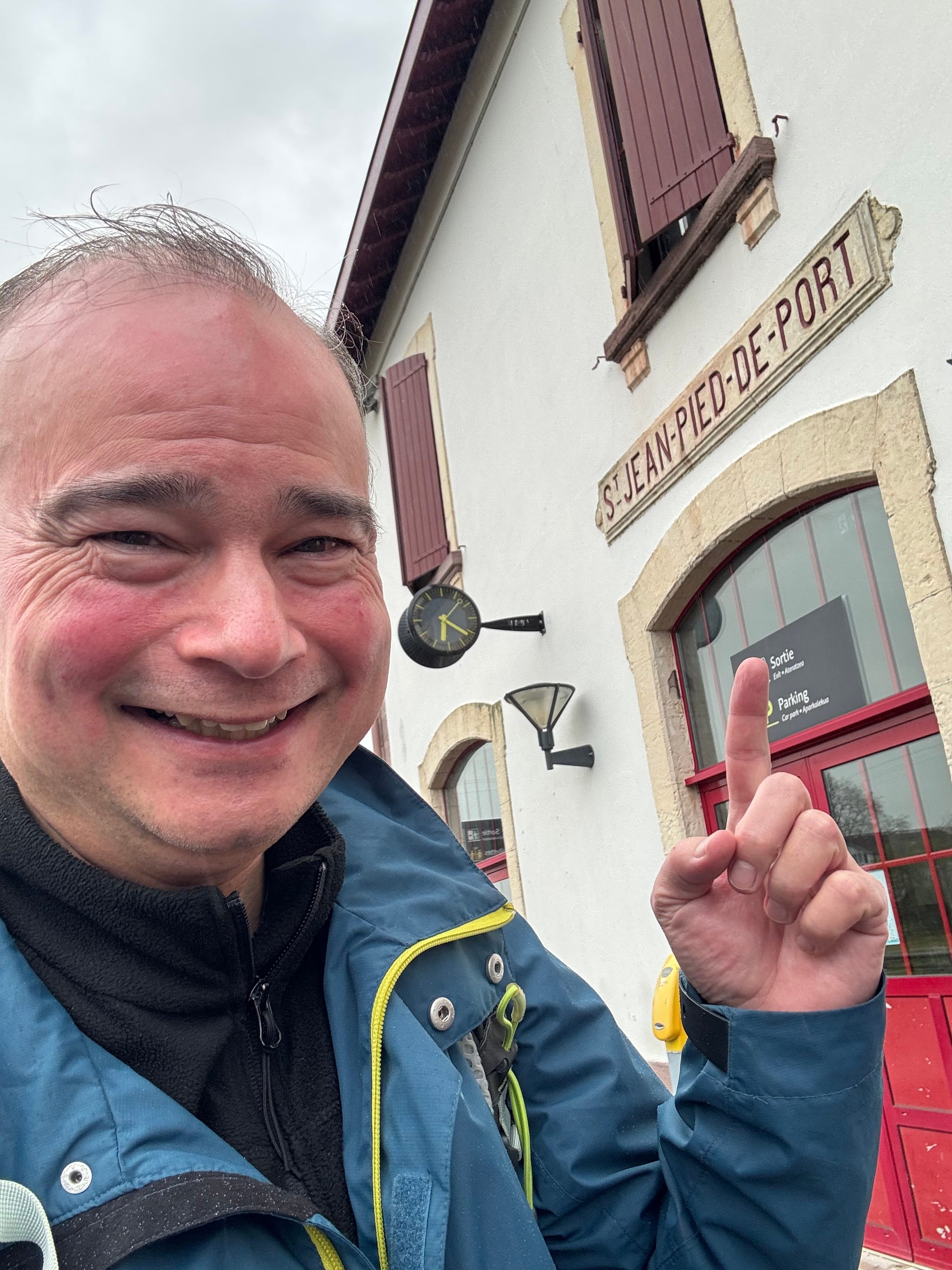
By the time the little train from Bayonne reached Saint-Jean-Pied-de-Port, I had already begun to recognize the other pilgrims.
Not by their faces.
By their backpacks.
Some looked brand new, still holding the sharp folds from the outdoor shop. Others had clearly seen years of use, faded by sun and rain, patched where the fabric had worn thin. Walking poles protruded at odd angles. Water bottles dangled from shoulder straps. Every now and then someone adjusted a hip belt that had probably been tightened and loosened a dozen times since leaving home.
The train itself was barely larger than a city tram. It rattled through the foothills of the French Pyrenees, stopping at villages that seemed too small to justify a station. Outside the windows, green hills rolled away beneath low clouds. Sheep grazed in fields bordered by stone walls. The closer we came to the mountains, the quieter the carriage became.
Nobody needed to ask why we were there.
The Camino had already introduced us.
Across the aisle sat a man from the Netherlands, just like me. We had met at the railway station in Bayonne, and by the time the train left, we were already talking like fellow travellers.
He had retired several years earlier.
His wife had died not long before.
Years earlier she had walked the Camino herself and had often spoken about returning together one day. They had always assumed there would be time. There always seems to be time until suddenly there isn’t.
He reached down beside his seat and picked up his walking poles.
They were purple.
“They were hers.”
He smiled when he said it.
Not the smile of someone who had stopped grieving, but of someone who had found a way to carry grief without letting it become too heavy.
When the train finally rolled into Saint-Jean-Pied-de-Port, we wished each other a good Camino and disappeared into the crowd on the platform.
I assumed that would be the end of our conversation.
I was wrong.


Outside the station, a cool drizzle drifted through the air. It wasn’t enough to send anyone searching for shelter. Instead it softened the colors of the town. The sandstone walls darkened with moisture. The slate roofs glistened. Rainwater gathered between the worn cobblestones before trickling downhill towards the river.
I had almost forgotten how beautiful Saint-Jean-Pied-de-Port is.
Or perhaps I had simply forgotten to notice.
The first time I arrived here, nine years earlier, I hardly saw the town at all.
I was too busy worrying.
Could I really walk eight hundred kilometers?
Would my body cope with the mountains?
Had I packed too much?
Too little?
Would I discover whatever mysterious transformation everyone seemed to promise the Camino would bring?
Back then every church, every bridge and every fellow pilgrim seemed to whisper that something extraordinary was about to happen.
Nothing unfolded quite as I had imagined.
Instead I found blistered feet, aching muscles and days when I was too tired to think about anything beyond the next village.
The great revelations I had hoped for never appeared.
Only much later did I realize that perhaps I had been listening so hard for big, life-changing answers that I had overlooked the smaller ones.
This visit felt different from the moment I stepped into the old town.
Nothing had changed.
The steep streets still climbed between old Basque houses, their whitewashed façades punctuated by dark timber shutters and weathered doorways. Flower boxes spilled over with red geraniums despite the rain.
Beneath the old bridge, the River Nive hurried through the centre of town exactly as it must have done when the first pilgrims passed this way centuries ago.
The town was the same.
I wasn’t.
Instead of arriving with expectations, I arrived with curiosity.
What would the Camino choose to show me this time?
That question was enough.
Only a handful of pilgrims lingered on the old stone bridge. One couple stood looking down at the river rushing beneath the arches. Another pilgrim paused for a quick photograph before disappearing into the narrow streets beyond. Most had already reached their hostels, leaving the town to settle into the slower rhythm of the evening.
I stopped there for a while.
Water has a remarkable way of putting time into perspective.
Long before anyone carried ultralight backpacks or followed GPS tracks across northern Spain, this same river welcomed merchants, soldiers, monks and pilgrims. Some came searching for forgiveness. Others for adventure. Some fled wars. Others fled themselves.
The river never asked why.
It simply kept flowing west.
Standing there, I realised I wasn’t setting out alone.
I was joining a procession that had been moving through this valley for centuries.
That thought made the journey ahead seem strangely less daunting.


At the end of the bridge, the road passed beneath the church’s bell tower. Halfway up, in a shallow niche between the clock and the bells, stood a solitary figure.
He stood in a shallow niche between the clock and the belfry.
One hand held a tall staff.
At his feet lay a lamb.
For a moment it looked almost as though he were watching the steady stream of pilgrims passing beneath him.
Or perhaps blessing them.
Why, I wondered, was John the Baptist standing here?
Not in Jerusalem.
Not beside the River Jordan.
But at the entrance to a small town in the French Pyrenees.
The answer, I suspected, would have to wait.


I ducked beneath the tower and stepped through the heavy wooden door of the church.
The church was filled with warm light.
The pilgrims’ Mass had already begun.
It was celebrated at an altar on the right side of the church, where a pool of warm light gathered around the congregation. A few dozen pilgrims had taken their places on the nearby pews. Others stood quietly at the back of the church. Backpacks rested against ancient columns. Walking poles leaned against the benches. The air still carried the scent of damp rain jackets, mingling with candle wax and old timber.
Outside, Saint-Jean-Pied-de-Port was settling into the evening. Inside, the rhythm was altogether different.
The congregation was younger than I had expected. Some people followed the readings attentively. Others simply sat in silence, absorbing the stillness before tomorrow’s climb into the Pyrenees.
People often say that the Camino has become a secular pilgrimage.
Looking around that church, I wondered whether the distinction mattered quite as much as we like to think.
Perhaps not everyone had come because they believed every word of the Creed.
Perhaps some had wandered in simply because they felt that the beginning of such a journey deserved a moment of quiet.
That, too, is a kind of pilgrimage.
Near one of the side chapels, two priests sat waiting to hear confessions.
Every few minutes someone quietly left a pew and crossed the aisle. No one hurried. No one looked around to see who might be watching.
I stayed where I was.
It wasn’t the confessions themselves that moved me.
It was what they represented.
Outside, everyone had spent the afternoon preparing. Checking equipment. Buying snacks. Filling water bottles. Discussing tomorrow’s weather and the notorious climb to Roncesvalles.
Inside, people were preparing in a different way.
Not by making their backpacks lighter.
By trying to make their hearts lighter.
I found myself thinking again of the figure above the town gate.
John the Baptist spent remarkably little time talking about himself.
The Gospels introduce him almost abruptly. After the extraordinary story of his birth to the elderly Zechariah and Elizabeth, he disappears from view. When he returns decades later, he has become an unlikely prophet, dressed in camel hair, living in the wilderness, surviving on locusts and wild honey.
He could have remained safely in the desert.
Instead, he chose the river.
There, standing in the waters of the Jordan, he invited people to begin again.
Not because water possessed some magical power.
But because stepping into the river marked a decision.
The old life remained on one bank.
The new one began on the other.
Perhaps every pilgrimage begins in exactly the same way.
Not with the first step.
But with the decision to take it.
When the Mass ended, pilgrims lingered in the church longer than I expected.
Some lit candles.
Others stood quietly before statues without taking photographs.
A few embraced before heading back into the drizzle.
There was no sense of urgency.
The mountains would still be there tomorrow.


Outside, the narrow streets had become livelier. Café terraces filled with hikers comparing maps over steaming bowls of soup. French, Spanish, German, English, Korean and Dutch drifted together through the rain.
The town seemed to speak every language except silence.
As I climbed one of the steep streets, I suddenly recognized the purple walking poles.
Their owner turned and smiled.
“So we ended up in the same place after all.”
Out of hundreds of pilgrims arriving that afternoon, we had chosen the same little hostel.
Inside, the atmosphere was unlike any hotel I had ever stayed in.
Shoes lined the wall by the entrance. Rain jackets hung drying from hooks and banisters.
The kitchen walls were covered with photographs of previous Camino journeys, smiling faces on mountain passes, dusty roads stretching towards distant villages, embraces outside Santiago Cathedral.
Karin, the hostel’s Dutch owner, greeted every new arrival as though welcoming old friends back home.
Over dinner she told us how a serious illness had changed her own life. It had taught her that plans are useful, until life has other ideas.
The Camino had reinforced that lesson.
“You don’t have to control the journey,” she said. “Just walk it.”
It sounded almost too simple.
Then again, perhaps the deepest truths often do.
Dinner was entirely vegetarian, served family style around one long table.
As plates were passed from hand to hand, introductions began.
One by one, each pilgrim told the story that had brought them here.
Some had recently retired.
Some had lost a parent.
One young woman admitted she had no idea what she wanted to do with her life and hoped that several weeks of walking might somehow help her discover the answer.
Nobody interrupted.
Nobody tried to solve anyone else’s problems.
People simply listened.
It struck me how quickly the Camino dismantles the invisible walls we spend so much energy building in ordinary life.
In the space of a single meal, professions, incomes and social status had quietly disappeared.
Nobody introduced themselves by saying what they owned.
Only where they had come from.
And where they hoped to go.


Listening around that table, I thought once more about the Jordan.
The crowds who gathered around John could hardly have been more different from one another. The Gospels mention soldiers, tax collectors, fishermen and villagers. Some belonged to the occupying Roman administration. Others lived under it.
Yet the river made no distinction.
Everyone entered the same water.
Everyone heard the same invitation.
Begin again.
Perhaps that is why pilgrimage creates friendships so quickly.
Every walker arrives carrying a different story.
Every walker begins with the same uncertainty.
Long before Jesus emerged from the crowds waiting along the Jordan, John had understood something that still feels surprisingly modern.
People change less through information than through experience.
He did not hand out scrolls explaining how life ought to be lived.
He invited people to step into a river.
Years later, when Jesus came to be baptized, John recognized that his own role was ending. According to the Gospel of John, he summed it up in a single sentence: “He must increase, but I must decrease.”
It is an extraordinary thing for someone so admired to say.
John never wanted followers for himself.
His purpose was always to point beyond himself.
Even his death reflected that courage.
His criticism of Herod Antipas eventually cost him his freedom and, later, his life. Imprisoned for speaking the truth, he was executed after a rash promise made during a royal banquet.
His story ends violently.
Yet that is not how he is remembered.
He remains the man who stood at the beginning.
The one who prepared the way.
That night I climbed into my bed in a dormitory shared with pilgrims from half a dozen countries.
The conversations gradually faded.
Someone folded tomorrow’s clothes with almost military precision.
A young woman laughed softly looking at a message on her phone before the lights finally went out.
My backpack stood ready beside the bed.
Everything I needed for the next few weeks was inside it.
Or at least I hoped it was.
Outside, I imagined the River Nive flowing through the darkness below the town walls.
Tomorrow morning we would eat breakfast together.
The hostel owner had promised us a small farewell ritual before everyone set off towards the mountains. None of us knew quite what she meant.
It didn’t matter.
Nine years earlier I had gone to sleep wondering whether I was capable of walking to Santiago.
This time I fell asleep wondering only what the road might decide to show me.
Beyond the open window, somewhere beyond the darkness, the Pyrenees waited.
Morning would come soon enough.
Thank you Father. Wonderful writing. I shared your journey on Facebook and I will follow along on Substack daily. I am 70 years old and overweight. I wonder if I can complete the Camino. Right now I will live vicariously through your experience.
I hope you will publish the whole book in English.