

Searching for coffee in the streets of Pamplona, I almost walked past the place where, according to tradition, the city's Christian story began. History, it turns out, can hide in plain sight.
Join me as I retrace my pilgrimage to Santiago de Compostela, weaving together my own experiences with the stories of the saints, churches and traditions that have shaped this ancient route for centuries.
You can find all published chapters in the table of contents.
The city was almost unrecognizable.
Less than twelve hours earlier, the narrow streets of Pamplona had been alive with voices. Restaurant terraces overflowed with people enjoying the first evenings of spring, and every square seemed to echo with conversation and laughter. Holy Week was about to begin, schools had just broken up for Easter, and visitors had arrived from across Spain to enjoy a long weekend in the old city.
Now, just after dawn, the streets belonged to someone else.
The municipal albergue had emptied before sunrise. Pilgrims quietly folded sleeping bags, gathered still-damp laundry from the rails around their bunks, and slipped out into the cool morning air. Behind us came the cleaning crews, preparing the former church for the hundreds of weary pilgrims who would arrive later that day.
Outside, Pamplona still seemed asleep.
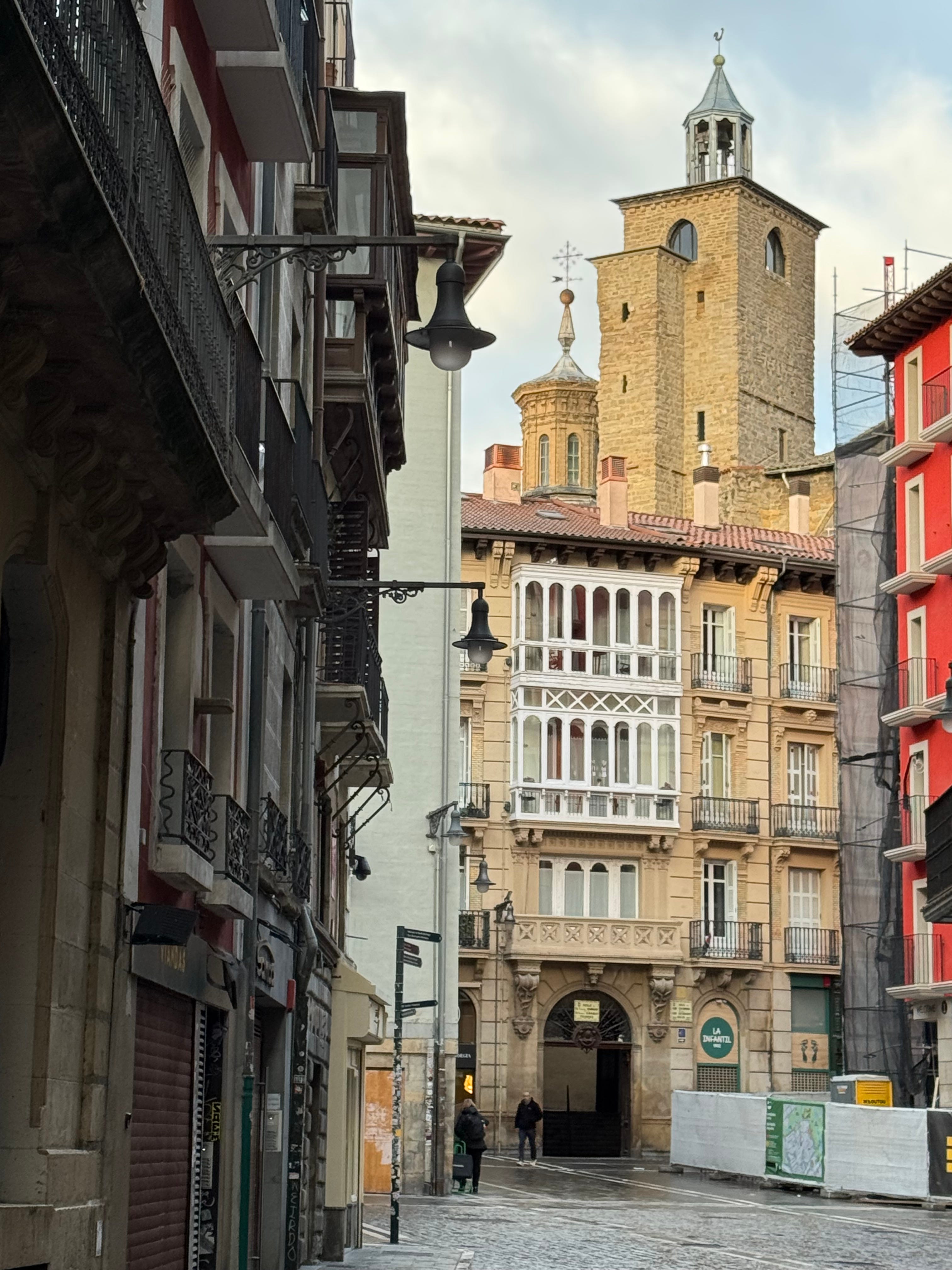
The medieval streets were wet from rain during the night. Tall stone buildings blocked the early sunlight, leaving the cobbles in cool shadow. The only sounds were the distant rumble of street-sweeping machines and the rhythmic hiss of their spinning brushes, washing away the traces of the evening before.
I hadn’t slept well.
Forty-two kilometers the previous day had left their mark on my legs, and the familiar chorus of snores inside the albergue had done little to improve the night’s rest.
There was only one thing on my mind.
Coffee.
I wandered through the quiet streets, hoping to find a café that had already opened its doors. Most were still dark. Chairs remained stacked on terraces, shutters closed, as though the city had decided to sleep a little longer after its celebrations.
Then I heard church bells. They made me wonder whether there might be an early Mass.
I changed direction and followed the sound through a maze of narrow streets until I reached the Iglesia de San Saturnino.
The church was closed.
A wrought-iron fence barred the entrance beneath the church’s arches, and beyond it the heavy wooden doors remained firmly shut.
Only then did I notice the statues.
Weathered by centuries of wind and rain, they stood on either side of the entrance.
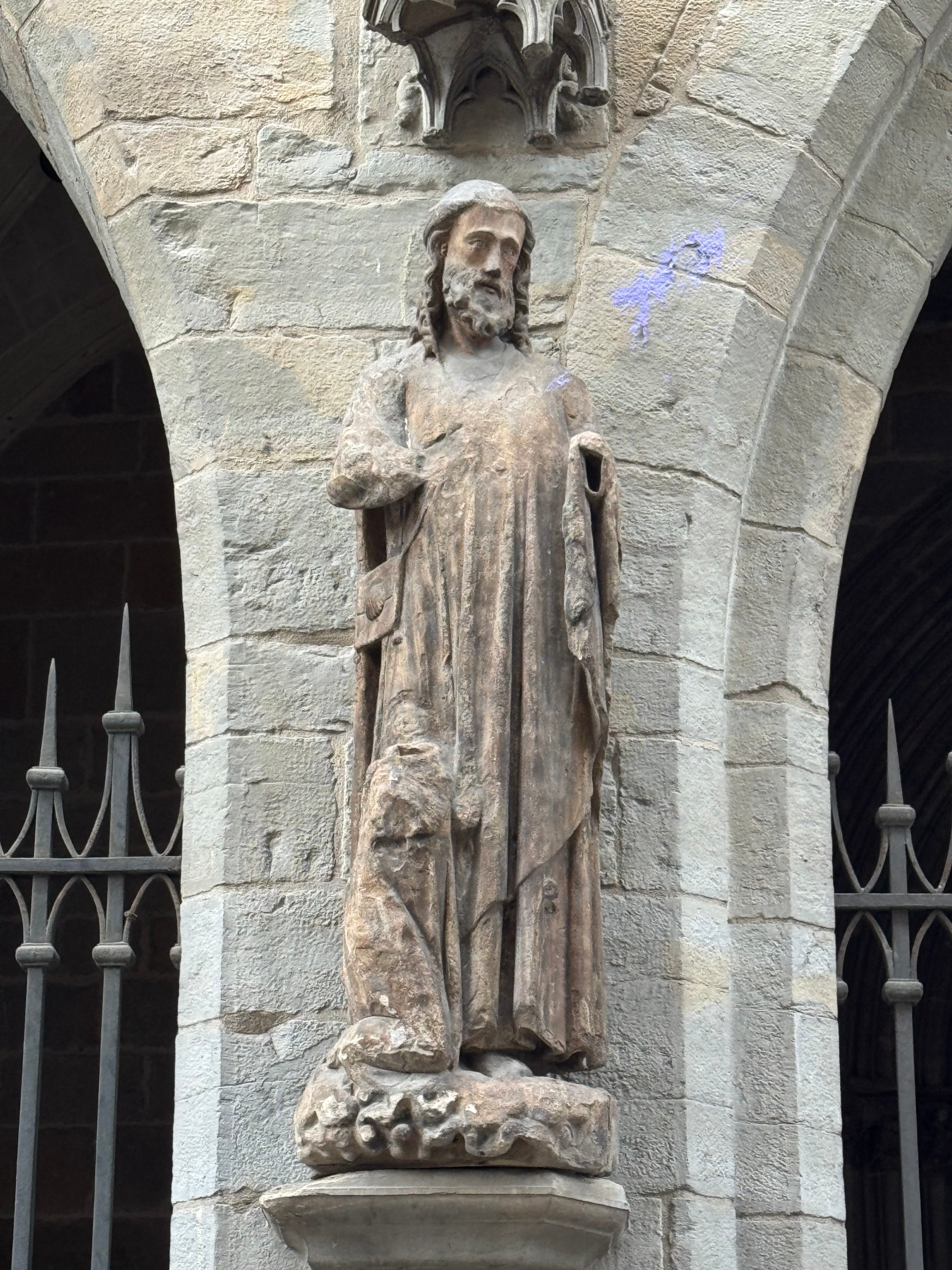
On the left was an unmistakable figure.
A bearded pilgrim carrying a satchel adorned with the scallop shell of Santiago.
Saint James.
Beside him knelt a much smaller figure with hands folded in prayer. Time had claimed the head, making it impossible to know whom the sculptor intended to portray. Perhaps it was a pilgrim asking Saint James for his blessing. Perhaps it was the donor who had commissioned the sculpture centuries earlier.
On the opposite side stood another saint.
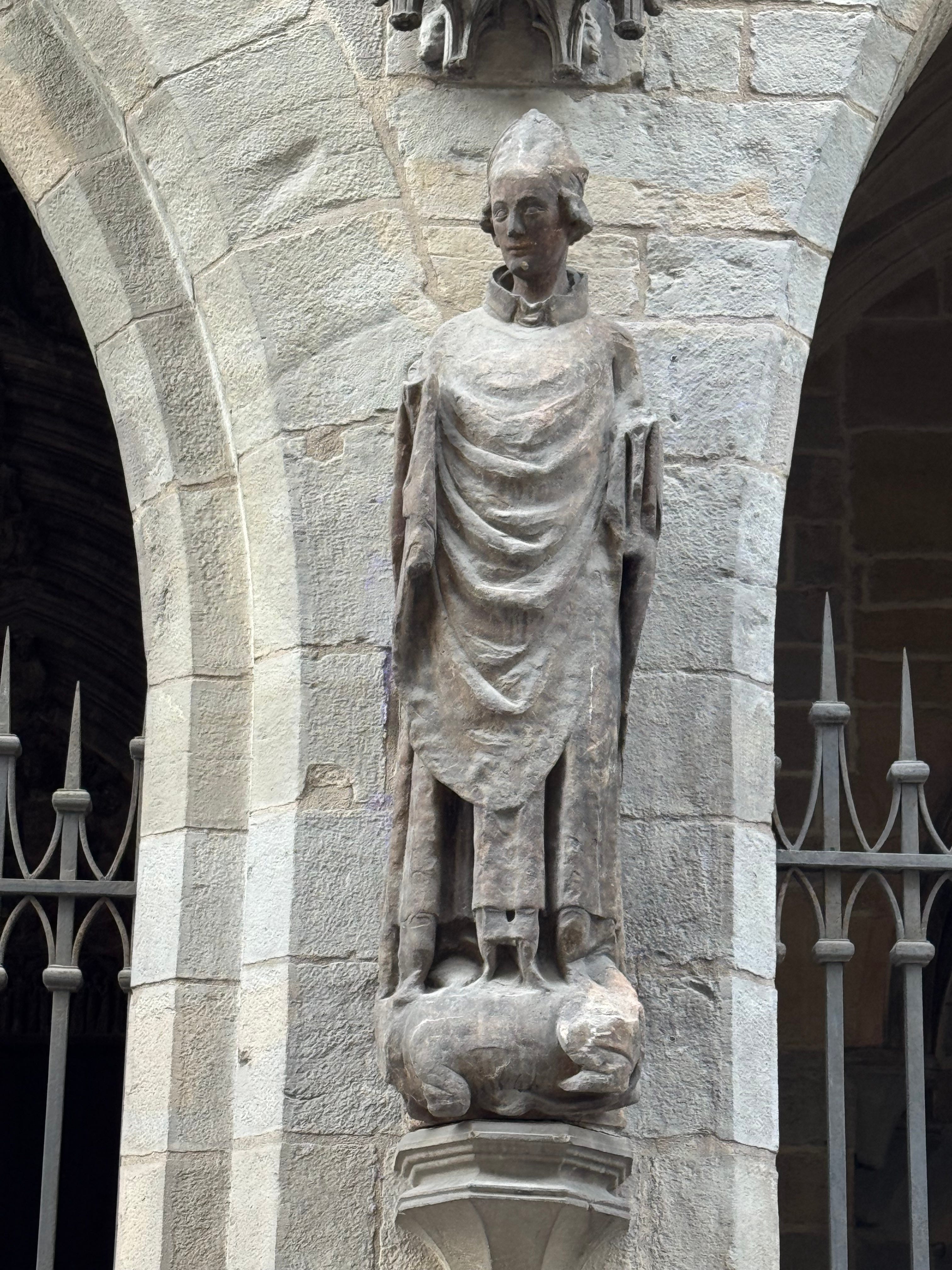
He looked surprisingly young.
He wore a bishop’s miter, though both hands had long since disappeared beneath the patient work of centuries of weather. At first I hardly noticed what supported his feet.
Then I looked again.
Four legs, a tail. Curved horns…
A bull.
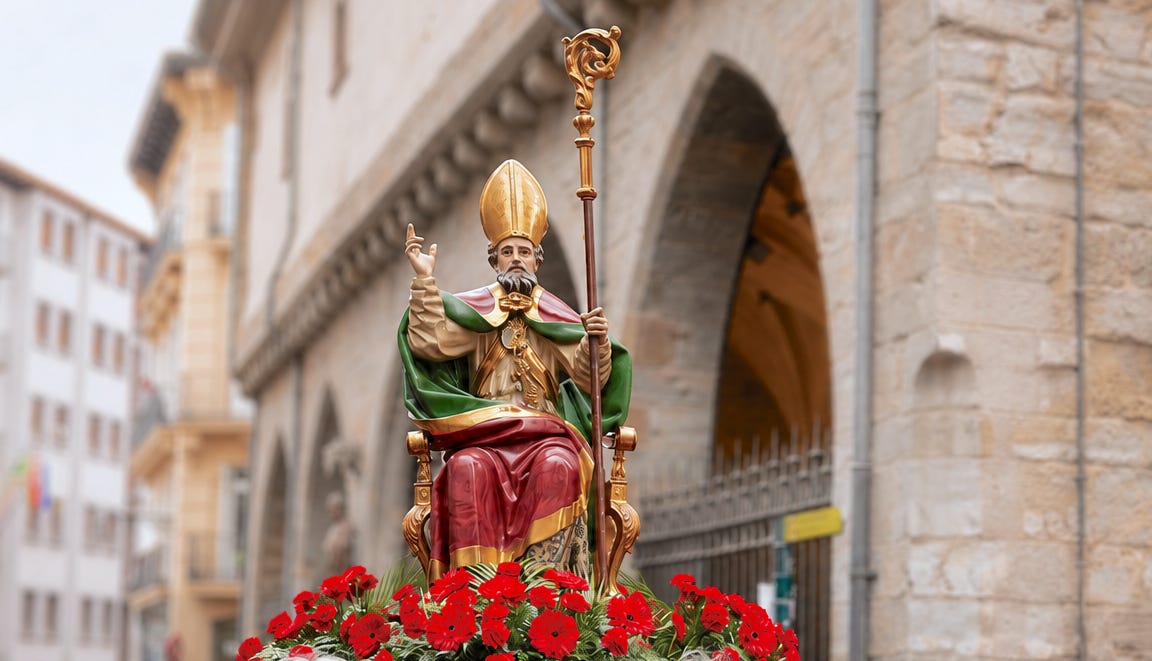
This could only be Saint Saturninus.
It was an unusual image.
Most visitors to Pamplona associate bulls with the famous summer festival of San Fermín. Seeing a bishop calmly standing on one felt almost absurd.
I made a mental note to find out why.
The church remained closed. I wandered along the narrow streets that wrapped themselves around the building, hoping to discover a side entrance.
Instead I found something far more unexpected.
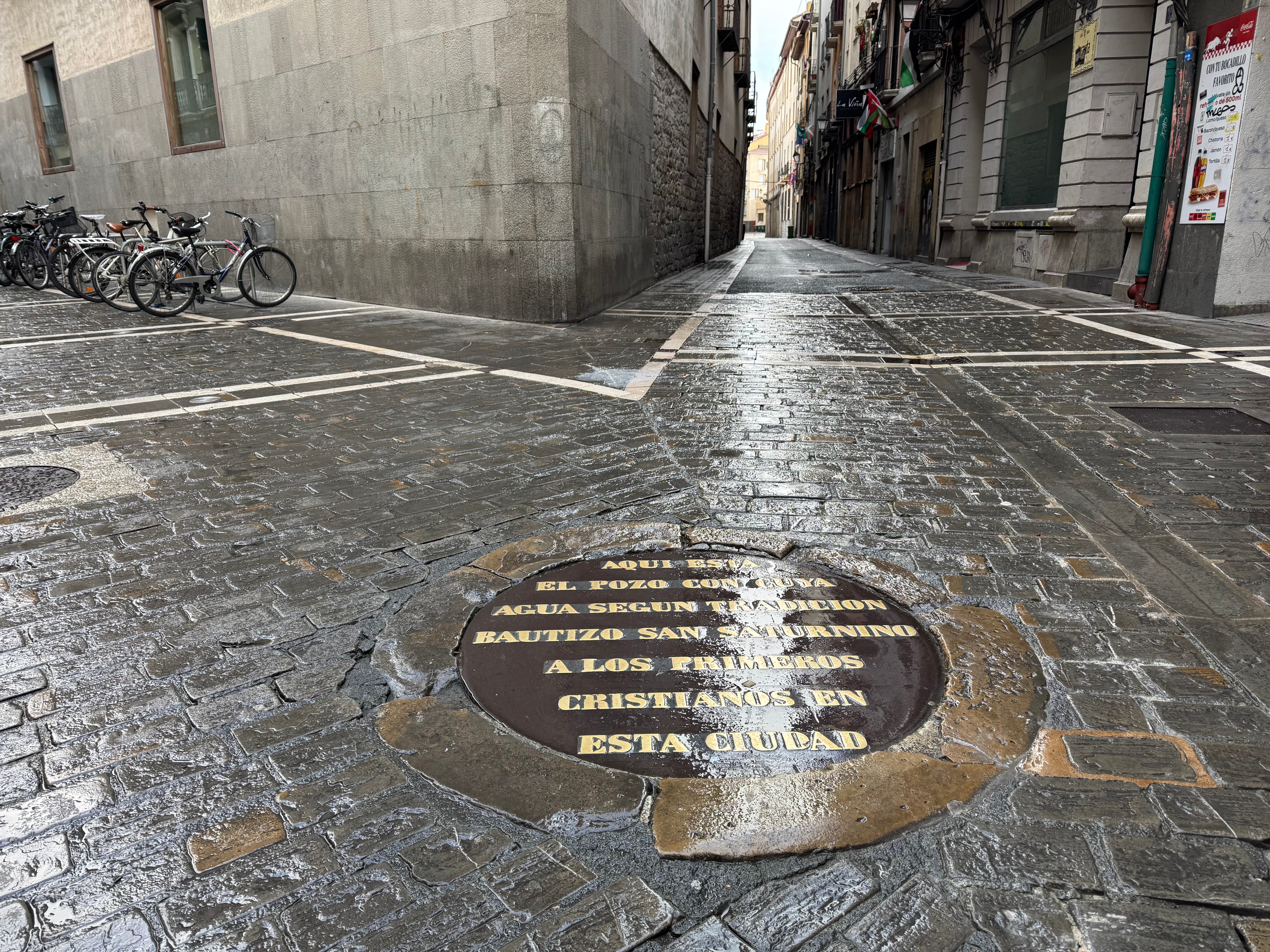
Set into the cobblestones where three narrow streets met was a circular bronze cover, framed by an uneven ring of old stone. It was so unobtrusive that I almost walked straight past it.
Only when I looked down did I notice the bronze inscription in its center. The rain had left the metal glistening, making the letters stand out against the dark surface.
According to the inscription, this marked the site of the ancient well where, according to tradition, Saint Saturninus baptized the first Christians of Pamplona more than seventeen centuries ago.
I stood there for several minutes.
Cars would soon be driving across this very spot. Thousands of people would hurry past on their way to work or school, scarcely noticing what lay beneath their feet.
Yet if the tradition is true, this tiny circle marks the place where the Christian story of Pamplona began.
Not with a cathedral or a solemn procession.
Simply with a well.
As I was taking it all in, the peaceful silence shattered.
A small white delivery van rounded the corner and squeezed past me.
Pan Fresco, fresh bread.
The words were painted cheerfully across its side.
The driver gave me an apologetic wave as he edged through the narrow street towards one of the bakeries.
Moments later a taxi appeared.
Then, just as the street became quiet again, the unmistakable roar of a street-sweeping machine echoed between the old stone buildings.
Its rotating brushes filled the square with a mechanical growl that seemed impossibly loud in the sleeping city.
The driver stopped only a short distance away.
Then he climbed out and lit a cigarette.
The machine, however, continued happily sweeping absolutely nothing.
I laughed.
Apparently history would have to wait.
After almost fifteen minutes, the driver finally finished his break, climbed back into the cab, and disappeared around the next corner with his noisy companion.
Silence returned.
I looked once more at the little stone circle.
How many people had stood here before me?
Tourists. pilgrims. Merchants. Children. Parents carrying babies to be baptized.
Generations who had built their lives around stories that began in places exactly like this.
The thought stayed with me as I wandered back towards the bakery van I had seen a little earlier.
The smell reached me before I saw the shop.
Fresh bread. Butter.
Warm pastry.
Coffee!!
It drifted through the street like an invitation.
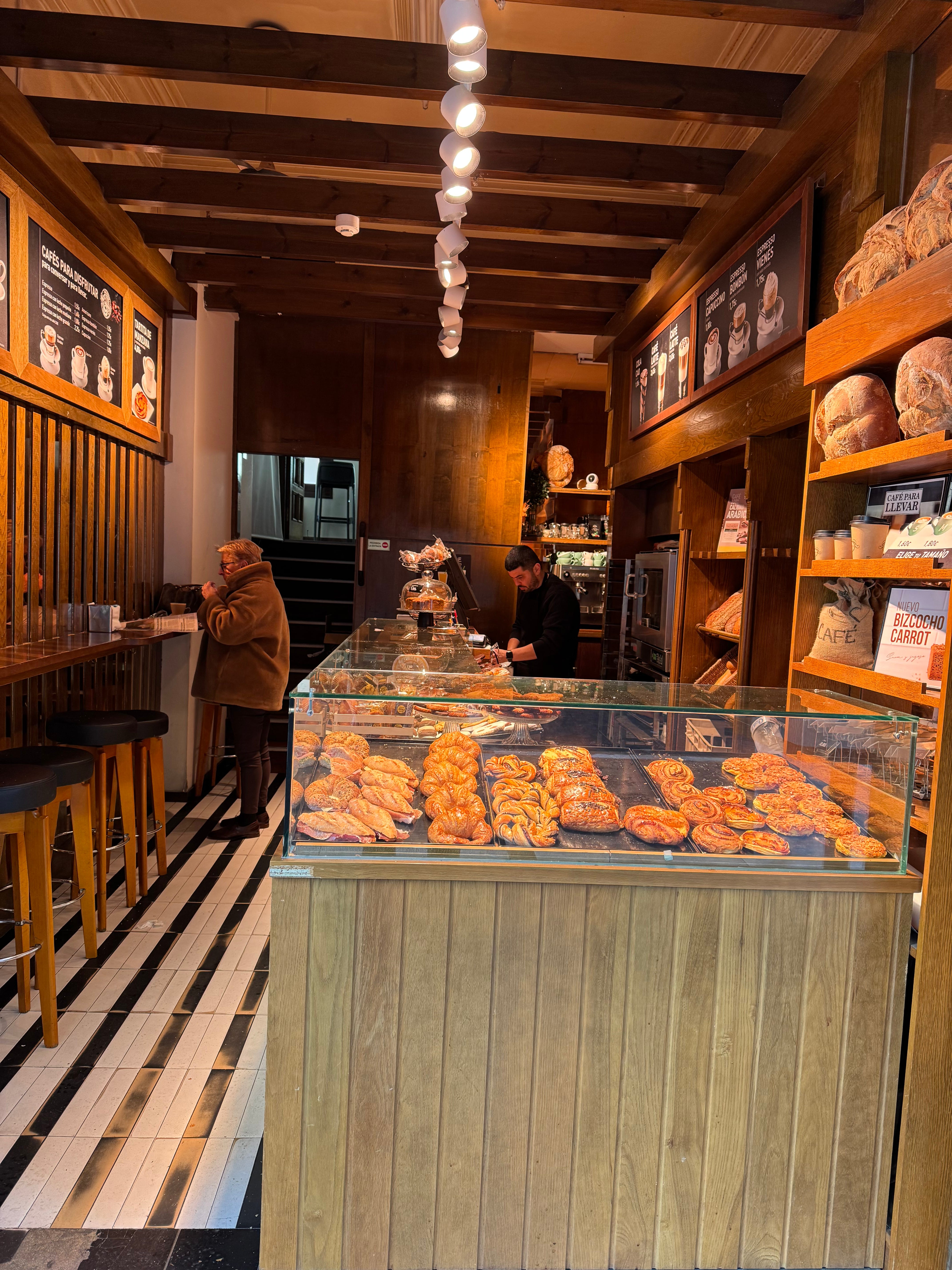
The sign above the window read Panadería Tahona.
Inside, polished wooden walls reflected the warm glow of hanging lamps. Behind a long glass counter lay rows of traditional Navarrese pastries, each one looking somehow even more tempting than the last. The espresso machine hissed rhythmically while a man behind the counter prepared coffee for an elderly customer sitting quietly with her morning newspaper.
For a moment I simply stood there.
One of the unexpected gifts of the Camino is that it quietly resets your senses.
At home, a cup of coffee is so ordinary that I barely think about it.
Here, after a cold night, tired legs, and an early start, the aroma alone felt almost luxurious.
The man behind the counter looked at me expectantly.
“What would you like?”
“Café con leche,” I said confidently. Coffee with milk.
Then I looked at the pastries.
There were far too many.
“I… honestly don’t know.”
He smiled politely but offered no advice.
At that very moment, the elderly woman beside me pointed decisively at a round glazed pastry.
“Ese, por favor.”
I looked at the baker.
“I’ll have the same.”
She had unknowingly solved the problem for me.
He asked whether I wanted to take breakfast with me.
I glanced at my backpack.
Soon I would be climbing out of Pamplona towards the Alto del Perdón.
There would be plenty of walking today.
“No,” I said.
“I’ll stay.”
For a little while longer, there was nowhere else I needed to be.
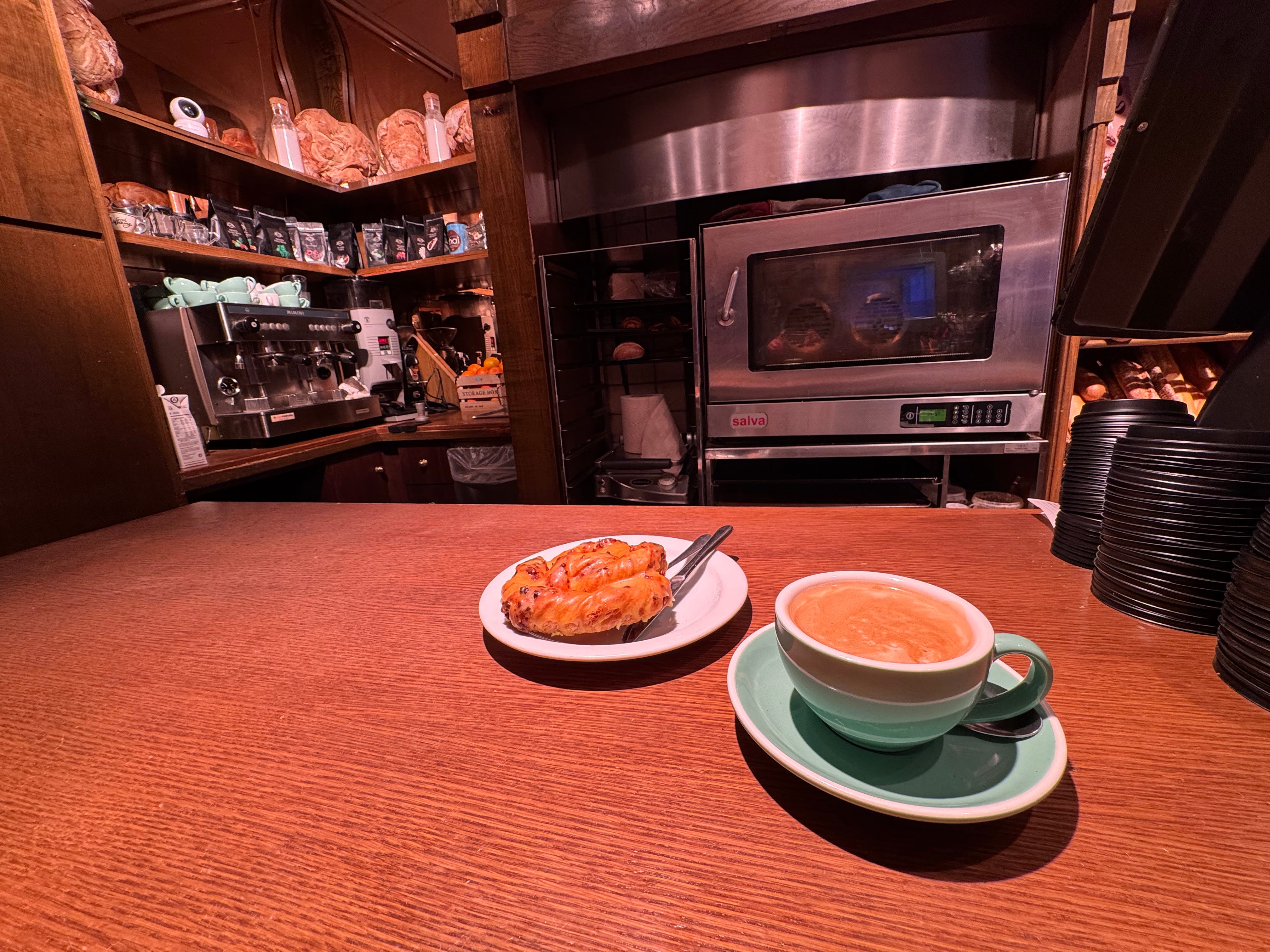
The first sip of coffee was glorious.
It wasn’t simply because it tasted good, although it certainly did. It was because, for the first time that morning, I wasn’t hurrying anywhere.
Outside, the city was slowly waking up.
Inside, time seemed to move at a gentler pace.
The elderly woman who had unknowingly chosen my breakfast exchanged a few cheerful words with the baker before taking her pastry to a small table by the window. Another customer stepped inside, greeted everyone with an easy Buenos días, and ordered coffee without even looking at the display. It was clearly part of his daily routine.
I envied him, just a little.
Pilgrimage has a curious way of stripping life back to its essentials.
You leave behind your favorite chair, your familiar kitchen, your own bed, the luxury of deciding exactly when to eat or sleep. For days your world becomes astonishingly simple. You walk. You look for a place to sleep. You wash your clothes. Then you begin again the next morning.
Perhaps that is why ordinary comforts begin to feel extraordinary.
A cup of coffee with creamy milk.
Fresh pastry, still warm.
A friendly smile from a stranger.
None of them are remarkable by themselves.
On the Camino, they feel like small celebrations.
I finished the last of my coffee, adjusted my backpack and stepped back into the streets of Pamplona.
The city had fully awakened. Shopkeepers were raising their shutters, neighbors greeted one another on the pavement, and the smell of fresh bread still drifted from the open front of Panadería Tahona into the narrow street.
Yet my thoughts kept returning to the little stone circle just around the corner.
It would have been easy to miss.
Perhaps that was precisely the point.
More than seventeen centuries ago, that place would have seemed just as unremarkable. A simple well. A bishop from Toulouse pouring water over the heads of a local nobleman named Firmus and his son, Fermín.
There was nothing spectacular about that moment.
Nothing that suggested historians would still be talking about it seventeen centuries later.
Saturninus had crossed the Pyrenees to share the Christian faith with people who had never encountered it before.
He did not arrive intending to change the course of a city’s history.
He simply spoke to the people he met.
The Camino had already taught me something similar.
When I thought back over the previous days, it wasn’t the mountain passes or famous churches that came to mind first. It was the people. A widower carrying his late wife’s walking poles. A Danish pilgrim grateful simply to be alive after months in hospital. A hostel owner inviting us to leave our expectations behind before setting out across the Pyrenees.
None of those encounters had seemed extraordinary at the time.
Yet they had stayed with me.
Perhaps history often begins in exactly that way.
With a conversation. With an unexpected act of courage or kindness. Or with one person willing to take the first step.
Saturninus himself could hardly have imagined what would grow from those first baptisms.
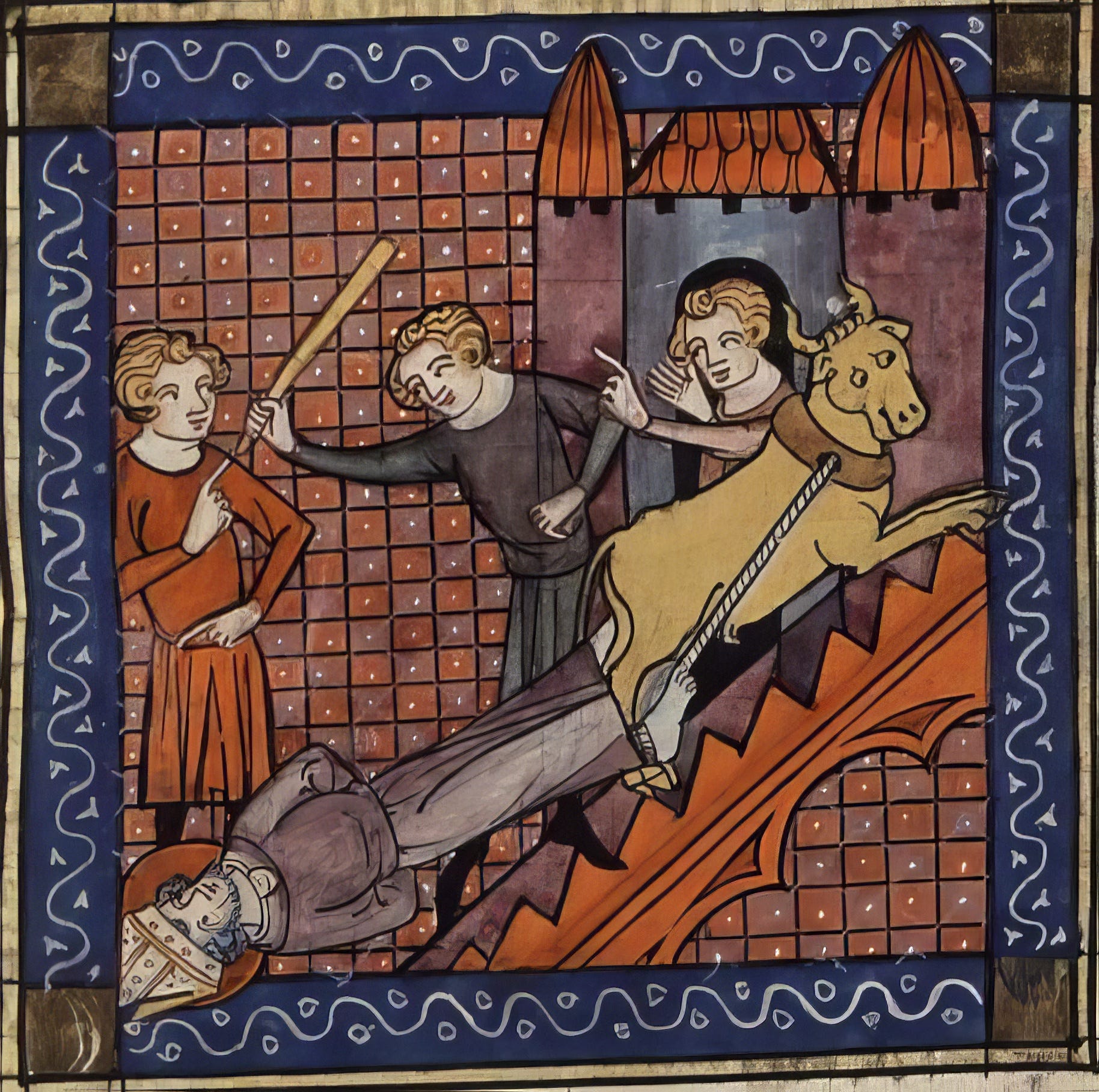
After establishing a small Christian community in Pamplona, he continued his journey and eventually returned to Toulouse, where he was martyred after refusing to offer sacrifice to Jupiter.
Bound to a bull, he was dragged through the streets until he died. That brutal end explains the curious statue above the entrance to the church, the young bishop calmly standing upon the very animal that had become the instrument of his death. In Christian art, the bull no longer represents violence, but the triumph of faith over it.
Standing in Calle San Saturnino that morning, though, I found myself thinking less about how his life ended than how it unfolded.
He arrived here as a stranger, a traveler from another country.
A pilgrim, in a sense.
He stayed only long enough to share what mattered most to him before continuing on his way.
That sounded remarkably familiar.
Every day the Camino receives people from every corner of the world. Most remain for only a night or two before disappearing over the horizon. We rarely learn what becomes of them afterwards. Yet now and then someone leaves behind a conversation or an example that changes another person’s journey.
Perhaps that was the real significance of the little stone circle.
Thousands of people crossed it every day without noticing.
Cars rolled over it. Children skipped across it on their way to school.
Beneath the ordinary rhythm of the city lay the memory of a beginning so small that almost no one could have recognized its significance at the time.
The Camino is full of places like that.
A weathered statue. A faded fresco in a forgotten chapel.
Unless you slow down, you simply walk past them.
Perhaps pilgrimage teaches us, above all, to notice.
Not only the great shrines and famous monuments, but also the ordinary places where history first takes root.
A simple well.
A traveling bishop.
A father and his son willing to change their lives.
Sometimes those small beginnings are enough to change the course of history.