

Author’s Note
I was often bullied in school. I remember the way laughter could sting sharper than sticks or stones—the way being singled out felt like being trapped in a cage you couldn’t escape. Writing ‘Sing Like a Bird’ gave me a way to turn that memory inside out. What if the victim’s voice became stronger than the bully’s?
The Funny Song
Eli first heard it in the hedge behind his mother’s house, a scruffy little brown bird with a chipped beak and twitchy wings.
Its song stopped him cold. Not beautiful. Not sweet. It was bent sideways, like a child trying to whistle through broken teeth. Crooked, funny, absurd. Eli doubled over laughing, the sound sticking in his head long after the bird fluttered off.
The next day he came back with a shoebox. He tossed in crumbs, balanced a stick under the lid. When the bird hopped inside, Eli yanked the stick away and slammed it shut. Triumph surged through him.
That evening, he marched down the street with the box rattling in his arms.
“Listen to this!” he yelled. He shook the box. The warped song spilled out, warped and silly, and his friends howled with laughter.
When the bird fell silent, Eli jabbed a stick through the air holes. The bird flinched, sang again, and the boys doubled over, tears running down their cheeks.
That night, Eli lay in bed smiling, replaying the laughter of his friends.
The Cruel Silence
By the third day, the bird stopped singing altogether.
He cranked his mother’s old radio and shoved the box beside it. He banged on the cardboard lid with his fist. He begged, coaxed, threatened. He poked his finger inside, jabbing until the bird flattened into the corner, wide-eyed, trembling.
Nothing. Not a single note.
Eli’s anger curdled into disgust. “You’re useless,” he hissed. “Stupid little freak.”
That afternoon he stomped into the field and flung the box open. The bird shot skyward like an arrow and was gone.
He walked home with a hollow sort of relief.
That night, the song returned.
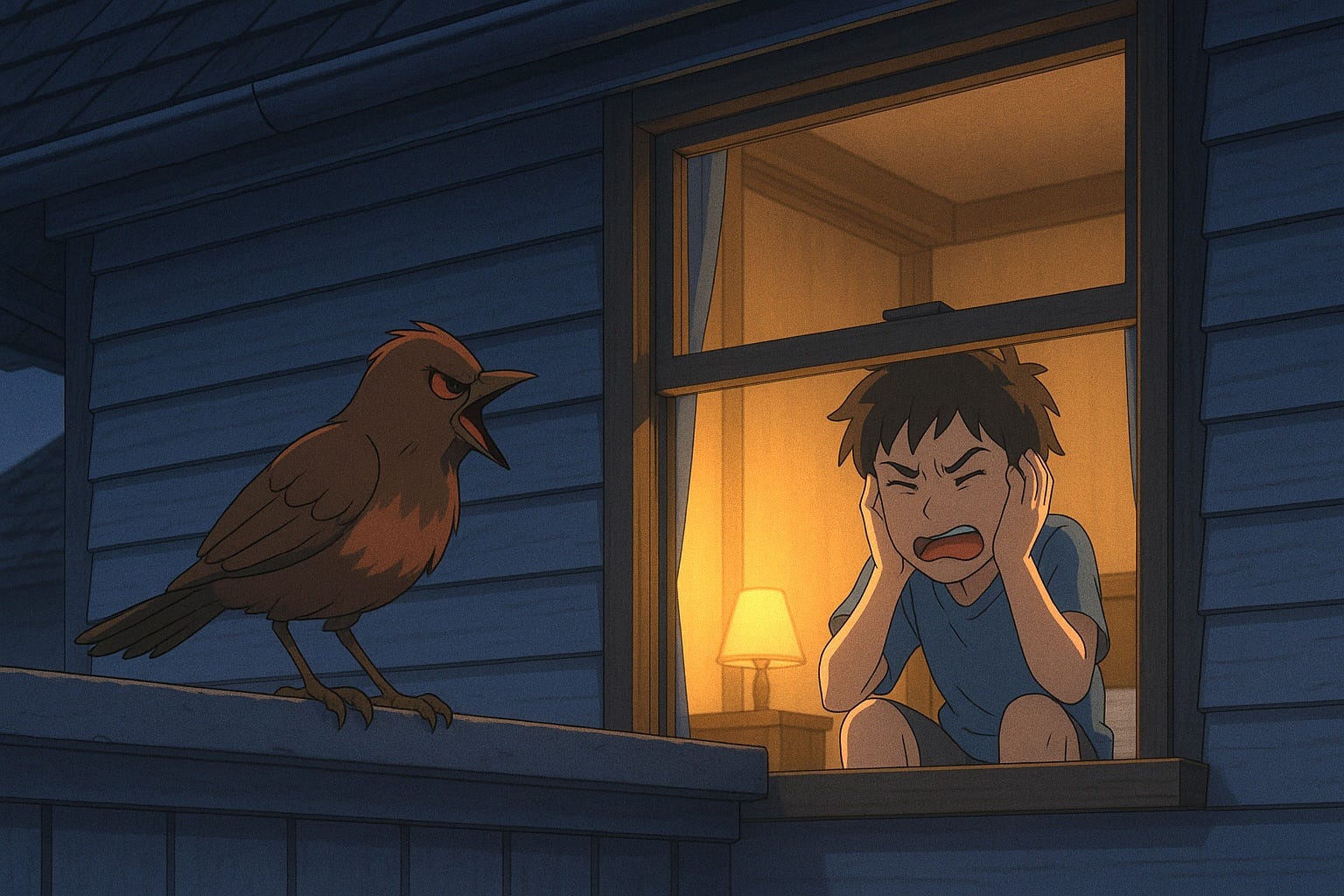
It woke him from sleep. The warped little tune, only louder now. Much louder. It filled the dark like a drill bit chewing through wood. Eli pressed the pillow over his ears, but it bled through the feathers, thin and merciless.
By dawn his eyes were bloodshot, his head pounding.
The Growth
The bird came back every night.
At first it perched on the windowsill, no larger than before. But Eli swore it looked a little different. Heavier in the chest. Feathers darker.
By the fifth night it had doubled in size. Its warped melody rattled dishes in the cupboard. His mother pressed her palms against her temples at breakfast.
“That awful noise,” she said. “Eli, what’s happening?”
“It’s not me!” he shouted, but she looked at him like he was lying.
Neighbors whispered. The butcher muttered about strange sounds keeping the whole street awake. Kids crossed to the other side of the playground when Eli passed. His grades slipped, his teachers shook their heads. Sleep never came, only the relentless song, hour after hour.
The bird grew bolder. By the second week it was hawk-sized. It followed him to school, perching on the fence, screaming its warped tune until the children ran indoors. Eli tried ignoring it, but shame burned his skin like fever.
At dinner one night, his mother’s hand shook so badly she dropped her fork. “I can’t live like this,” she whispered. “I need… peace.”
The next morning, her suitcase was waiting by the door. She kissed Eli’s forehead, eyes wet, and left for her sister’s. “I’ll come back when it’s quiet again,” she promised.
But it was never quiet.
The Killing Attempts
One evening, Eli armed himself with stones from the driveway. His hands shook as he crouched in the dark, hurling rock after rock at the silhouette on the roof. Once, he thought he saw feathers puff into the air. His heart leapt—had he hurt it? Had he won?
But the bird only ruffled its wings, as if shaking off dust, and launched into a song so violent that the windowpanes rattled and a picture crashed from his wall. Eli dropped the stones, stomach turning to water.
A few nights later, he set a trap he’d found in the garage, the kind meant for rats. He baited it with bread, placed it beneath the windowsill, then sat awake in bed, waiting. Around midnight came the snap. He bolted upright, heart hammering, relief flooding him. But when he pulled the curtain, his throat closed. The trap lay twisted, metal bent like clay. Above it, perched and gleaming, the bird sang with twice its former force. The walls buzzed. Eli slid down the wall and covered his ears, weeping.
His last hope came with his father’s old BB gun. Rust spotted the barrel, but it still worked. He stood in the yard, breath clouding in the night air, and fired again and again until the gun was hot against his palms. The pellets vanished into the feathers. The bird rose from the chimney, spread its enormous wings, and let loose a blast of sound so powerful it knocked Eli to his knees. He dropped the gun, the taste of blood in his mouth from where his teeth had rattled together.
Each time, he had believed—believed he could beat it, silence it, escape it. And each time the hope died, smothered beneath the growing weight of that song.
By the end of the month it was wolf-sized, hunched on the roof, its chest swelling like a furnace. The song pouring from its throat was no longer even music. It was laughter. Mocking, endless, merciless.
The Reckoning
Eli stumbled into the yard barefoot, pajamas clinging with sweat. “Stop!” he shrieked. “Please, I’m sorry!”
The bird tilted its head. Then dropped. Its claws pinned him in the dirt. The beak opened wide and the sound poured out—a scream of joy, of cruelty, of mockery.
The hedges rustled. The trees shook. Birds poured into the yard—sparrows, starlings, thrushes, blackbirds—hundreds of them, wings beating, eyes glittering.
They circled him, shrieking with laughter. Then they began to poke. Sharp little beaks jabbing at his arms, his legs, his ribs. Each time he screamed, they shrieked back in delight, a grotesque parody of the nights he’d rattled the shoebox, forcing their captive cousin to sing.
The garden erupted with sound, a hideous chorus that swallowed Eli’s cries until he was only another note in their song.
A Final Warning
No one lives there now. The houses stand hollow, shutters loose, gardens overgrown. Birds circle overhead, shrieking as if laughing at some private joke.
And when dusk falls, if the air is still, travelers swear they hear it: that crooked little song, funny and absurd, floating from a hedge.
If you hear it—walk away. Do not linger. Do not get closer.
And under no circumstances… try to catch that bird.
Thats quite the unforgiving little bird 😅 It reeds like a nightmare and it actually made me uncomfortable. Great job.
Wow! What a story!